Total Productive Maintenance (TPM) Consulting Services From TXM Lean Solutions
Technology enabled approach
Are you getting the most out of your factory? As industry 4.0 technology sweeps the world, factories become more complex, more interconnected and reliability becomes even more critical. The failure of one element of an automated production line can bring production to a halt.
“Preventing breakdowns” is not enough to achieve the levels of performance you need. TXM goes beyond reliability takes a holistic approach to asset performance with our practical, effective, technology enabled approach to Total Productive Maintenance (TPM).
The Problem with Traditional Approaches to TPM
Many businesses have tried to implement TPM, and few genuinely succeed. Studies have shown that around 70% of companies fail to sustain TPM in their operations. We think that this is as much about the approach taken for implementation as it is about the companies themselves.
Typical TPM approaches are too complex, too bureaucratic and rather than leveraging the technology available, seems to have an aversion to technology. TPM is built on eight pillars, but some advocates increase this to as many as eleven pillars, adding to the complexity. Its little surprise that many companies become overwhelmed with all the paperwork and checklists involved in traditional TPM approaches and give up.
We have created the Total Productive Maintenance self-assessment, try it out today.

Why the TXM Approach to TPM is Different
At TXM we take a practical approach, emphasising the key TPM pillars of Focused Improvement, Autonomous Maintenance, Preventative and Predictive Maintenance and problem solving. We believe that autonomous maintenance, and therefore TPM will fail if employees are not highly engaged. Therefore, we build autonomous maintenance and TPM on strong Lean foundations of Practical 5S® and Lean Leadership.
Asset Performance Goes Beyond Preventing and Fixing Breakdowns
Traditional reliability approaches focus on implementing preventative and predictive maintenance to move away from reactive maintenance (breakdowns) to planned maintenance. However, improving the Overall Equipment Effectiveness (OEE), the key measure of asset performance is about more than preventing breakdowns. At TXM we look at all aspects of OEE including startups, changeovers, centrelining, crewing, material logistics, and scheduling.
Embracing Industry 4.0 Technology in TPM
At TXM we look to leverage technology in the quest to improve asset performance. Whether it is computerised maintenance management systems (CMMS) managing maintenance resources, manufacturing execution systems (MES) tracking and reporting operational performance or advanced IoT sensors providing early warning of problems, TXM understands and leverages these systems to track and drive improvement.
The challenge is to make sense of all the data being provided to manufacturing leaders and determine what information matters – that is our skill.
The TXM Process for Total Productive Maintenance
At TXM, TPM follows our proven process:
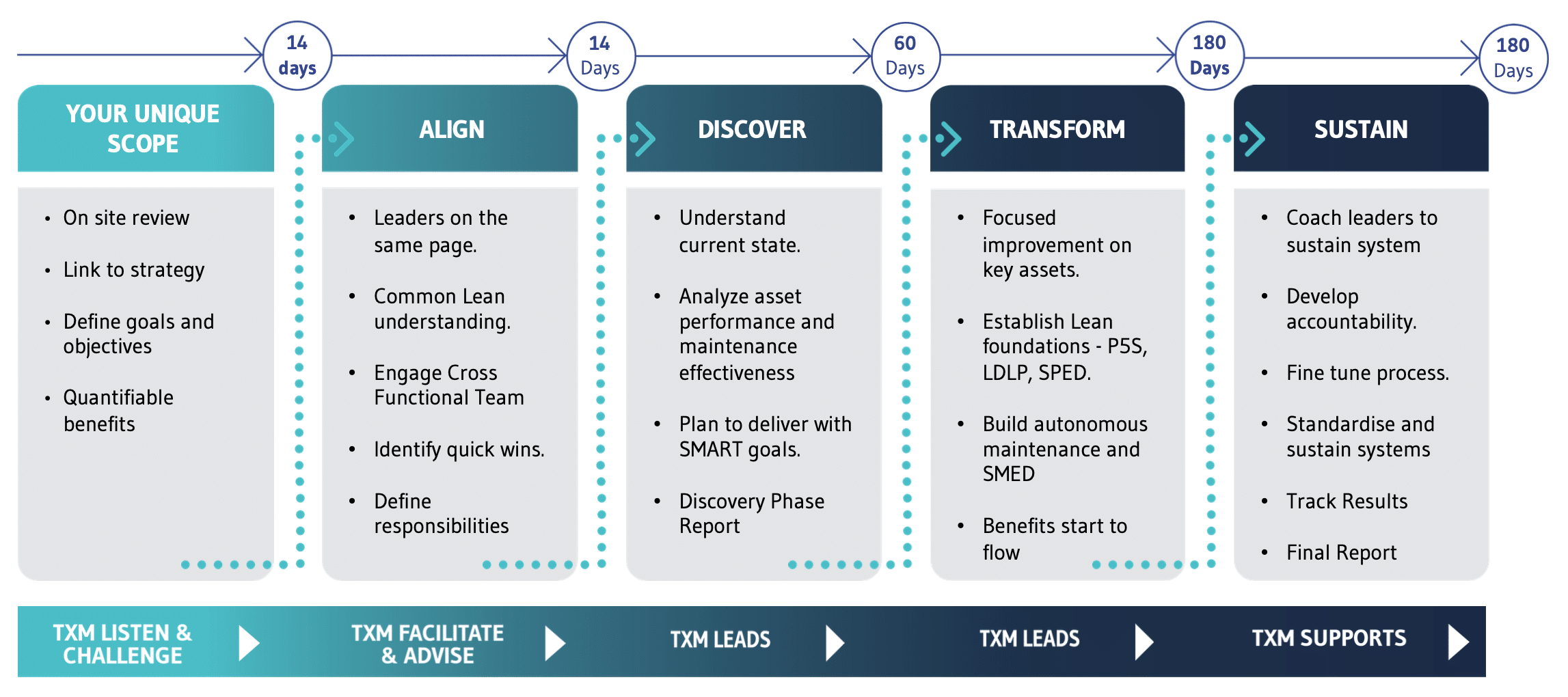
Focused Improvement Delivers Results
At TXM we will work with you to highlight the critical assets in your business and develop a specific plan to deliver breakthrough performance improvements. We take a deep dive in to your data to understand every aspect of the performance of the asset and work with you to develop actions that will deliver measurable and sustainable improvements in performance on the machines that matter most.
Autonomous Maintenance the Key to Achieving Exceptional Performance
Autonomous Maintenance engages front line operators in caring for machines. Operators spend the most time with your machines and often understand their problems and performance better than anyone else. At TXM we tap in to this knowledge, engaging operators in deep cleaning, inspection, centrelining and where appropriate and safe, tightening and lubricating key assets. Operators become the eyes and ears of the reliability effort.
The Difference between Autonomous Maintenance and “Operator Maintenance”
How Autonomous Maintenance Compares to Caring for Your Car
Are You Getting the Best Return on your Maintenance Spend?
In highly automated manufacturing, engineering and maintenance is becoming a growing share of your cost base. However, are you getting the best return for this investment. At TXM we will work with your team to analyse how you use your maintenance resources, ensuring that time and money is directed to the areas that will have the biggest impact on asset performance. Over time, our approach to TPM has helped companies half their maintenance spend, while improving asset performance and asset life.
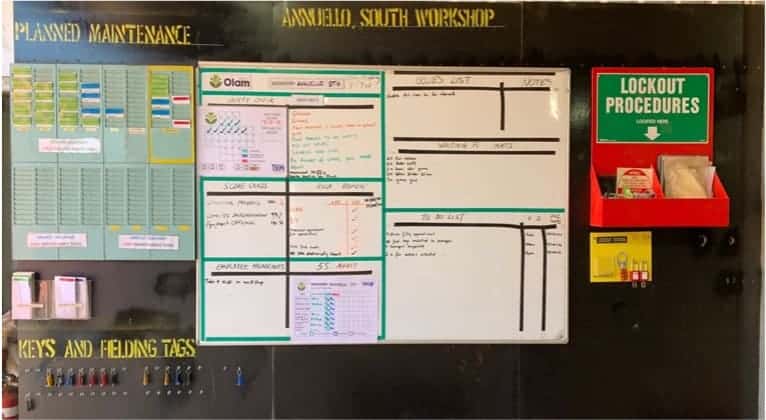
Maximising the Effectiveness of Your Maintenance and Engineering Teams.
At TXM we look at maintenance effectiveness and help you find answers to some key questions:
- Are your preventative maintenance programs directed effectively to deliver the best return on effort?
- Is the mix of pro-active and reactive maintenance right?
- Are you using predictive maintenance tools (including IoT) effectively?
- Are maintenance programs aligned to the asset lifecycle?
- When things are fixed, do they stay fixed? Is the quality of your maintenance high enough and are handovers from maintenance to operations effective?
- Do you have the right maintenance and engineering structure and resources?
TPM Built on Lean Foundations
TPM “specialists” will often promote TPM as an alternative to Lean. Some even suggest it as a total solution for operational excellence and “Total Productive Maintenance” becomes “Total Productive Manufacturing”.
At TXM we see TPM for what it is, which is an effective approach to maximise asset performance through maximising OEE.
We think for TPM to be effective it has to be built on Lean foundations. For that reason our TPM projects usually start with establishing Lean foundation tools:
- Practical 5S® provides the foundation for autonomous maintenance by setting a standard for the cleaning and presentation of equipment and starting the conversation about machine care.
- Lean Daily Leadership Process® focuses operational and engineering teams on improving the key metrics such as OEE and setup times and provides constant feedback on the success of TPM efforts.
- Solving Problems Every Day® gives operational and engineering teams to learn from the things that go wrong and improve. This can mean finding the real root cause of breakdowns and poor performance.
As well we leverage our skills in Single Minute Exchange of Die (SMED), Every Part Every Interval scheduling and other key Lean techniques to drive improved OEE.
Frequently Asked Questions About Total Productive Maintenance
What is Total Productive Maintenance (TPM)?
TPM is an approach to maintenance orginally developed in the 1960’s by Nippon Denso in Japan and then developed in to a defined system in the early 1970’ by Seiiji Nakajima through the Japan Institute Of Plant Maintenance (JIPM).
The key difference with TPM is that rather than seeing reliability as the preserve of maintenance and engineering teams, TPM takes a holistic view and involves all employees, operational and maintenance in improving all aspects of asset performance.
Operations and engineering teams are focused on working as a team to improve a common metric, Overall Equipment Effectiveness (OEE).
What is OEE?
Overall Equipment Effectiveness (OEE) is an overall measure of asset performance.
It measures the output of an asset compared to its “nameplate” capability and therefore provides a transparent assessment of how well the asset is achieving its potential. Importantly OEE is a result of both reliability and operational performance and should be a shared goal for both engineering and operational teams. OEE is the multiple of three key metrics:
- Availability – is the machine running or is it down due to breakdowns or setup delays?
- Performance – if the machine is running, is it running at maximum design speed accounting for idling, slow runnings and minor stops?
- Quality – is the machine producing quality products or is it producing defects.
What is Autonomous Maintenance?
Often mistakenly referred to as “operator maintenance”, autonomous maintenance is about engaging operators in routine care of the machinery they operate. Typically this includes:
- Deep cleaning of machines to remove build-up of dirt that may cause problems in operation or cover up problems (such as lubricant leaks)
- inspection of the machine to highlight problems or potential problems during operation.
- Lubrication of key equipment, including greasing or topping up lubricants.
- Tightening of loose guards, chains, belts or other parts.
Operators need thorough training and clear work instructions, often expressed in “single point lessons”, to be able to perform autonomous maintenance tasks correctly and safely.
Why Can Lean Transformations Fail?
Lean transformations fail when they do not engage people and, particularly leadership within an organisation. Team leaders and team members must see the relevance of the Lean approach to their work and must believe that Lean will help them achieve their personal and team goals.
The TXM approach specifically addresses this challenge by ensuring that the Lean Transformation in your business will be completely aligned to the objectives of your business and the needs of every site.
How Long Does a TPM Project Take?
At TXM we follow our proven process. The first step is initial analysis of your asset performance and development of a plan to improve it.
Then we will develop a master schedule for your site to implement the plan. Typically, this plan will have a duration of 12-18 months depending on the size of your operation and the current maturity of your reliability processes.
Why Do So Many TPM Projects Fail?
We think that many people overcomplicate TPM and make it too bureaucratic. At TXM we will start with the systems, processes and tools that you already have and build on these rather than discarding what might be working well.
Our focus is always on seeing TPM as a means to achieve improved asset performance rather than seeing the methodology as an end itself. TPM is often deployed in a top down manner.
While leadership and support from the top is essential, at TXM we work with you to engage people at all levels in providing their ideas and creativity in improving machine performance.
Why do People Resist Autonomous Maintenance?
Many businesses will find strong resistance to autonomous maintenance. Operators see it as extra work and worry that they will be blamed if things go wrong and machines get damaged. Maintainers worry that their work (and livelihood) will get taken away and that they will still have to fix up the mess when “operator maintenance” is done incorrectly. Both of these concerns are valid and need to be considered and addressed. At TXM we aim to engage operators and maintainers first before asking them to embark on autonomous maintenance. We involve them in focused improvement and 5S cleaning so that they can discover for themselves the problems with machines and be part of developing solutions. Simple one point lessons provide clear guidelines on how tasks should be completed. We aim to shift the mindset from “operators break” and “maintainers fix” to a culture where operators and maintainers work collaboratively to solve problems and improve asset performance.
How Can I Speak To Someone About Integrating TPM Into My Business?
Contact TXM Lean Solutions to discuss TPM strategies and consulting options that can help your business grow.