Walk into a plant that has just finished spending real money on modernising, and the floor often looks exactly as it did two years ago. The equipment is newer. The problems are identical.
Modern manufacturing is usually explained as a shopping list: automation, sensors, cloud platforms, a new ERP. That list tells you what a supplier sells. It tells you nothing about whether your plant is modern.
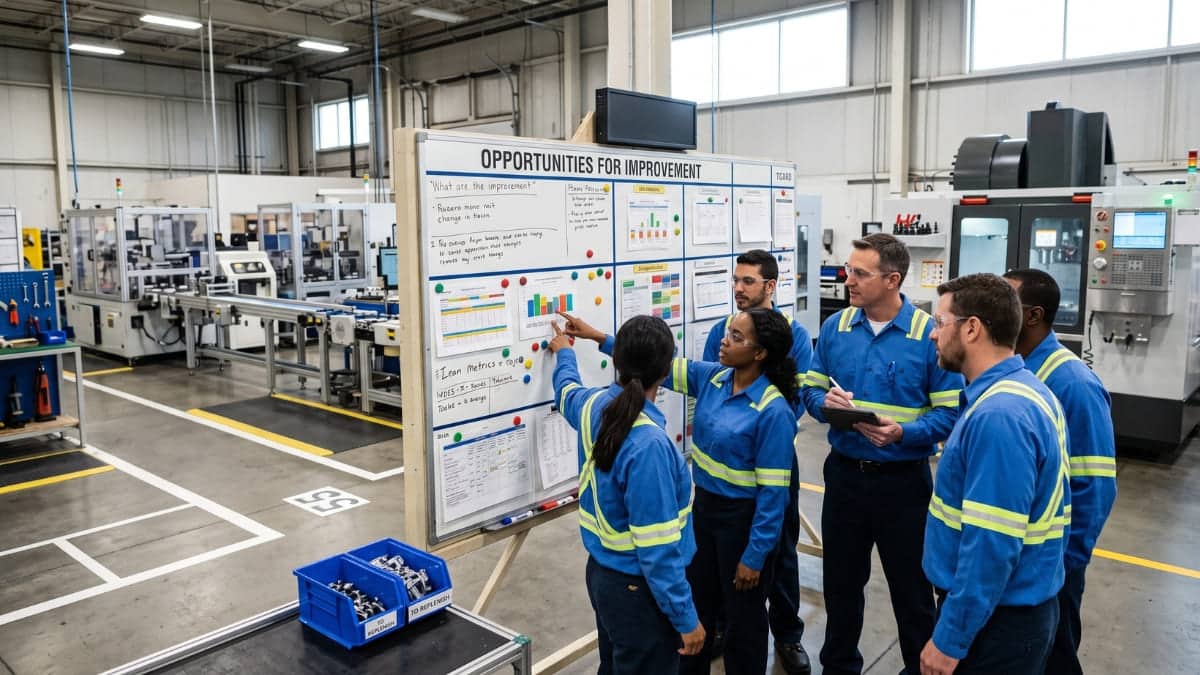
Modern manufacturing is defined by how a business runs and improves every day. It shows up in lead time, in how fast a problem becomes visible, and in who is trusted to fix it. Continuous improvement is the mechanism, not the marketing.
This piece sets out what that looks like on the floor, how to assess your own operation against it in ten minutes, and where to start when there is no capital budget to spend.
What Modern Manufacturing Actually Means
Take two plants in the same sector, the same size, making broadly the same thing. One has spent heavily on new technology. One has not. From the floor you can tell within ten minutes which one is modern, and it is not reliably the one with the newer equipment.
A modern operation is one where the work is standardised, the flow is short, abnormalities are visible within the hour, and the people doing the work are the ones improving it. That definition survives a board meeting. Every part of it is observable, and every part of it moves a number the business already reports.
Manufacturers rank it that way themselves. In TXM’s Global Manufacturing Snapshot Report 2025, 60% of manufacturing leaders said lean manufacturing would be their primary improvement strategy for the year ahead, ahead of new technology adoption and outsourcing. That survey covers manufacturing leaders across Australia, New Zealand, North America and the UK. It is not one market’s opinion. It is the industry’s own ranking of what changes performance.
The fundamentals have not moved. Flow still determines lead time. Quality made at the source still costs a fraction of the same defect caught at final inspection or returned by a customer. Standard work is still the only thing that makes a result repeatable across shifts and people. Levelled demand still beats a heroic recovery every week of the year, and none of that depends on what a plant makes or where it sits.
Technology does not replace those fundamentals. It amplifies whatever is already there. Put a broken process on new equipment and you get the same chaos, faster and more expensive than before.
If that definition holds, it explains what the technology definition cannot: why so much modernisation spending produces so little visible change on the floor.
Why Most Modernisation Programmes Fail To Stick
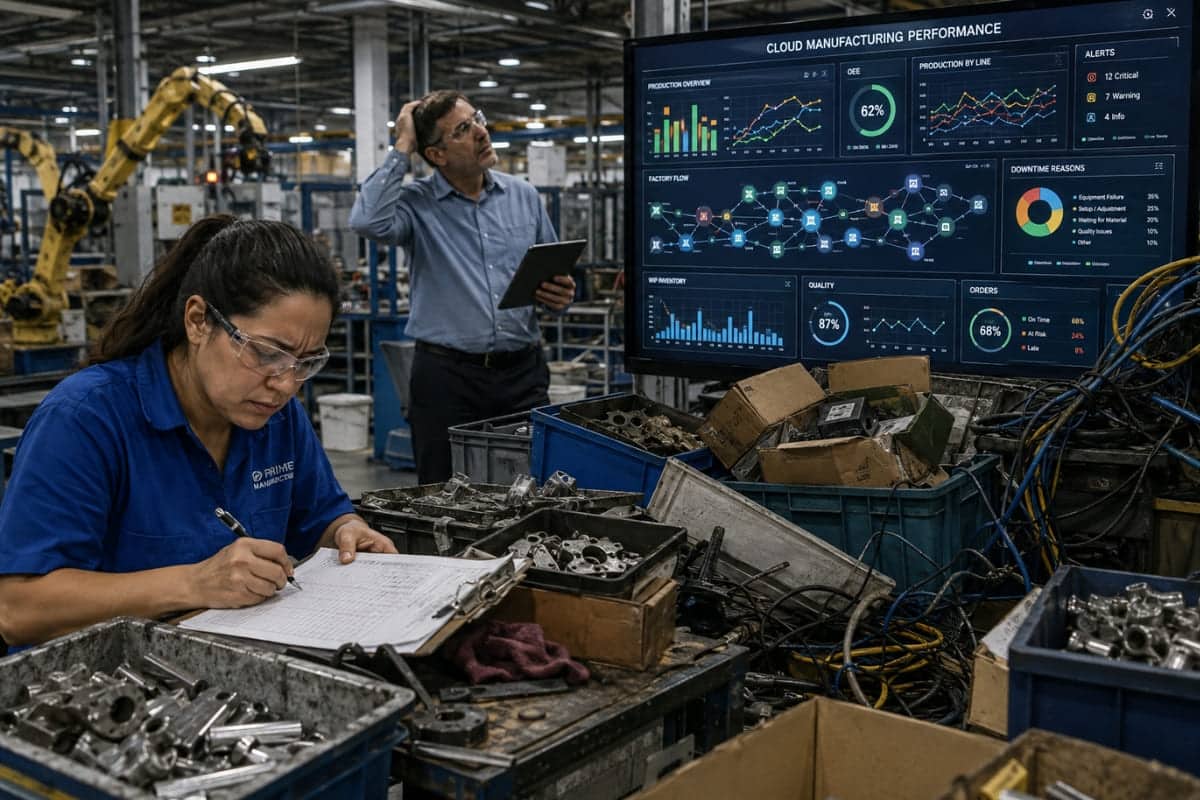
According to TXM’s Global Manufacturing Survey, fewer than 40% of software projects in manufacturing are meeting or exceeding expectations. Process automation projects do only slightly better, at under 50%. Both figures come from TXM’s Global Manufacturing Snapshot Report 2025 and its survey of manufacturing leaders across Australia, New Zealand, North America and the UK.
The independent research lands in the same place. BCG’s 2020 study found that 70% of digital transformations fell short of their objectives: 30% fully succeeded, 44% created some value but missed their targets, and 26% fell well short. BCG’s separate analysis of 850 companies put the share of digital transformation projects reaching their stated goals at roughly 35%, and McKinsey’s 2018 global survey found only 16% of respondents said their transformation both improved performance and sustained the improvement. Different samples, different years, different markets, same answer.
The root cause is not the technology. McKinsey’s transformation research repeatedly identifies organisational culture as one of the main obstacles. The mechanism is straightforward. Technology gets introduced without anyone aligning it to how the process is actually executed in the workplace, so the new standard never holds. The familiar symptom is pilot purgatory, where a plant builds a working pilot cell and never scales it, because what made the pilot work was attention, not the tool.
Leaders reach for the large fix anyway, and the pressure behind that is real. In the same TXM survey, over 50% of manufacturers reported softer sales year on year and named it their single biggest challenge. Skilled labour is hard to attract for 60% of them, and 80% have adjusted their supply chains since the pandemic, most commonly by bringing production back in-house.
Margins are tight, cheaper competitors are close, and a capital purchase feels like decisive action in a way that changing a shift routine does not.
The failure is not in the technology. It is in what was already true of the operation on the day the technology arrived.
The Walk Test: How to Tell If Your Operation Is Modern
You do not need a maturity model or a consultant to place your own plant. You need ten minutes and four things to look at: the boards, shift handover, how an abnormality gets escalated, and how much material sits between operations.
| What you look at | A struggling operation | A modern operation |
|---|---|---|
| The boards | Charts of last month’s data, nobody standing at them | Today’s numbers, updated by the team, showing whether the shift is winning or losing right now |
| Shift handover | Verbal and informal, running on the longest-serving operator’s memory | Run to a standard, with open issues carried forward by name |
| Escalating an abnormality | The supervisor works around it, the manager hears next week | Flagged the moment it happens, owner and date assigned the same shift |
| How long problems stay open | Recurring, reopened, never closed | Closed with a countermeasure and locked into standard work |
| Material between operations | Piles of WIP held as insurance against unreliability | Small, deliberate, sized to a known replenishment rule |
| Who owns improvement | A CI manager and a project list | Every team member, every day |
| When the champion leaves | It stops | It continues, because the capability transferred |
The boards tell you what leadership reviews
A Lean Daily Leadership board is where anyone can post what got in their way: a mistake that disrupted flow, a stock-out, a missing or bad tool, a wrong standard, a safety issue. Read the notes on it. An empty board is not evidence of a stable operation.
It is evidence that nobody believes posting on it changes anything.
Watch what happens when a problem is raised
Karen Martin tells of a Toyota plant where a supervisor was asked to flag quality problems on a car with Post-it notes before a visiting executive arrived. Staff were too afraid to point out problems, so the car came out nearly bare until they were pushed to paper it with the real issues. Psychological safety is the precondition for every other row in that table, not a soft extra.
Gemba walks are not spectator sports either. Walk the same patch regularly, walk it with a stated purpose, and watch the team leader huddles rather than the machines.
If the boards row is where your operation lands on the left, start there. None of the other rows can improve while problems stay invisible.
The Operating System Behind a Modern Plant
Most plants have already tried daily meetings. They either stopped within a few months or turned into a ten-minute status read-out that changed nothing. The difference is not the meeting. Consistency on the floor never sustains itself. It is a direct reflection of what leaders review and reinforce, day after day.
That is why the mechanism behind a modern operation is rather than tooling. Four components do the work:
- The Lean Daily Leadership Process: structured daily meetings at team level and site level, held at the same time each day, against performance the team can see.
- Standard work, so a result is repeatable across shifts and people rather than resting on who is rostered on.
- , which makes root cause discipline a daily habit rather than an occasional workshop.
- Value stream mapping, so the whole flow gets improved instead of one station getting faster while the queue in front of it grows.
Visual management and 5S support all four by making the standard, and any deviation from it, visible at a glance.
The outcomes are specific. A global coatings manufacturer producing colour-matched coatings for consumer electronics, working to short model lives and automotive-grade tolerances, ran a cross-functional value stream mapping workshop and cut lead time by 60%. On another value stream mapping engagement, teaching the client’s own people to see the whole process took lead time from 6.4 days to 3.6 days, a 44% reduction, and released around USD $770,000 of inventory.
At Laminex, value stream mapping traced long lead times and high cost back to rework and inspection labour. An Andon system let operators flag problems the moment they occurred, paired with SPED and concern strips, and both quality and OEE improved. Ferguson Plarre Bakehouses, a family-owned industrial bakery supplying 76 stores, found that poor work practices followed them into a brand new site. TXM used 5S as the platform for the Lean Daily Management System, with a communications board, daily departmental meetings and a daily site-level meeting, then applied value stream mapping to the key product lines.
None of those results came out of implementing a software tool. They came out of changing what leaders look at every morning, then transferring that capability to the people running the line. TXM consultants are former manufacturing and operations leaders who coach on the floor, on your real problems, because this is learned by doing it.
A system that depends on a champion or an external consultant has a scheduled end date, whether or not anyone has written it down. A system where the capability sits with the team survives the next reorganisation, the next resignation and the next downturn.
Where Technology Fits, and What Has to Be True First
The World Economic Forum’s Global Lighthouse Network has been recognising advanced production sites since 2018, across more than 30 countries, and after seven years of additions it has recognised only around 220 sites in total. Set that against the world’s entire manufacturing base and the scarcity is the finding. Every technology in those plants is available to buy, so availability is clearly not the constraint.
What separates them is that they are whole-system transformations rather than tool purchases. Generative AI use cases accounted for 23% of the top solutions identified in the 2025 cohort, but the AI sits on top of stable processes rather than standing in for them.
So the useful question is not which technology. It is what has to be true before any of it pays back. Confirm five things before signing anything:
- The process you are eliminating is not waste and cannot be completely eliminated rather than automating.
- The process being automated is stable and standardised, so you are not encoding a workaround at speed.
- The data the tool consumes is trusted by the people who generate it, or nobody will act on what it says.
- The uptime baseline is known, so you can tell later whether the tool moved it.
- Someone on the floor owns the outcome it reports, by name.
Skipping that sequence is expensive and common. TXM’s Global Manufacturing Snapshot Report 2025 found that around 40% of manufacturers struggle to integrate new technology with their existing systems, and 35% are unsure of the return on their technology upgrades. Strengthen the process foundations first, then layer digital capability on top as reinforcement of how the work is meant to be done.
Technology is worth buying. It is worth buying second.
Where to Start Without a Capital Budget
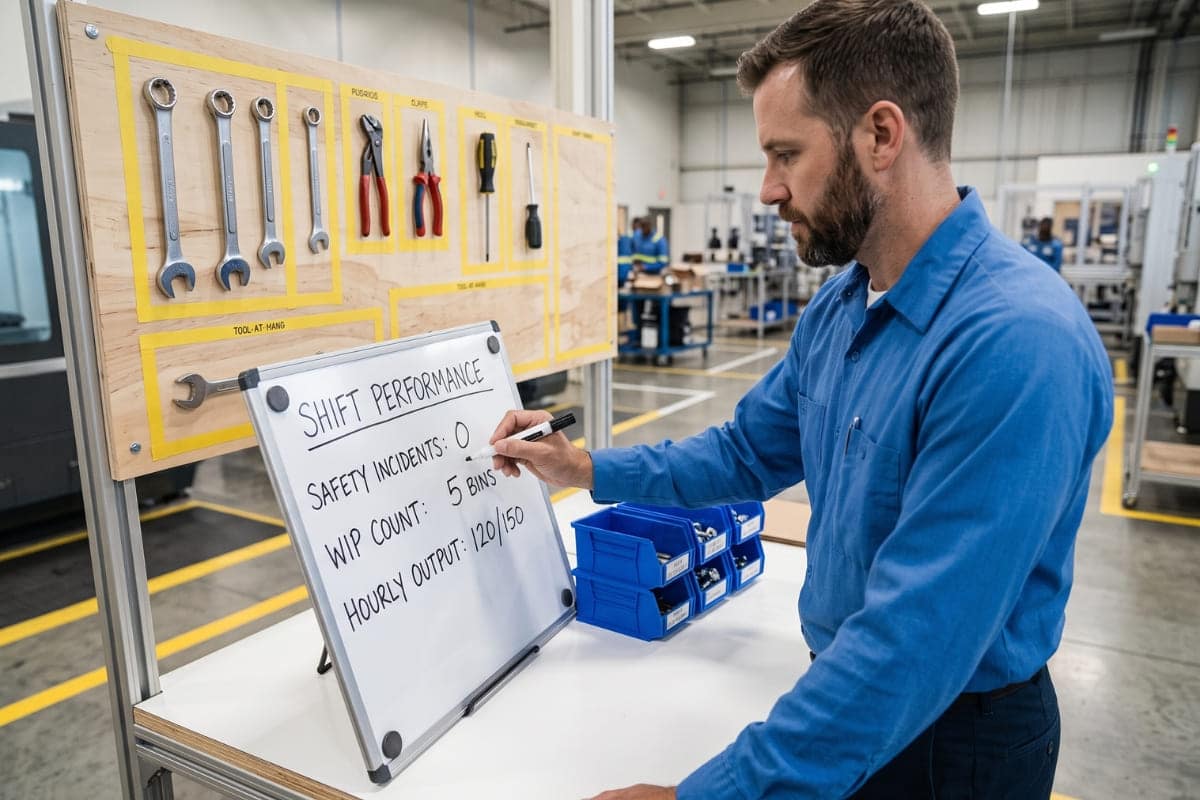
None of what follows needs a capital approval. It needs about 90 days of leadership attention, which is the scarcer resource in most plants but the one you already control.
Four moves, in this order:
- Run 5S in one area. Not the whole site. One area, to reset workplace order and make the standard visible enough that a deviation is obvious to anyone walking past.
- Put up one board that shows today’s performance, owned and updated by the team rather than by an analyst. Three numbers the team can actually change before the end of the shift.
- Hold a short daily meeting at that board, at team level and then at site level, at the same time every day. What leaders review is what holds.
- Give the team one structured method to take a problem to root cause and close it into standard work, then work the board’s live issues through it.
This is not fast and it is not effortless. It is the pattern TXM used at Ferguson Plarre and at Laminex, and it works because it changes the daily routine rather than the asset register. It also makes every later technology decision cheaper, because by the end you will know which processes are genuinely stable and worth automating.
The bottom line: modern manufacturing is not a purchase. It is a standard of running the business, and it is fully available to an operation that cannot afford to buy anything at all this year. Sixty per cent of manufacturing leaders already say lean is where their improvement effort is going. They are not choosing it because it is cheap. They are choosing it because it works.
If you want a second opinion on where your operation actually sits, . A consultant who has run a floor will walk yours with you and tell you what they see.
Common Questions About Modern Manufacturing
What Is Modern Manufacturing?
Modern manufacturing is an operating standard, not an equipment list. It describes an operation where work is standardised, flow is short, abnormalities surface within the shift, and the people doing the work are the ones improving it. Two plants with identical technology can sit on opposite sides of that line, which is why the definition is about how the business runs rather than what it owns.
Is Modern Manufacturing The Same As Industry 4.0?
No. Industry 4.0 describes a set of technologies. Modern manufacturing describes how an operation runs and improves. The two can coexist, but one does not produce the other. In TXM’s Global Manufacturing Snapshot Report 2025, 60% of manufacturing leaders named lean manufacturing as their primary improvement strategy for the year ahead, ranking it ahead of new technology adoption.
Why Do So Many Manufacturing Modernisation Projects fail?
Because technology gets layered onto processes that are not stable, and the leadership and adoption side goes unaddressed. TXM’s 2025 survey found fewer than 40% of software projects and under 50% of process automation projects meet or exceed expectations. McKinsey’s research points to culture as one of the main obstacles. The pattern is consistent across markets.
What Are Modern Manufacturing Methods And Processes?
The methods that matter operationally are value stream mapping, standard work, the Lean Daily Leadership Process, structured daily problem solving, visual management and 5S. Production models such as job shop, batch, repetitive, continuous and discrete are often listed as modern manufacturing processes, but they describe what a plant makes and how it is configured, not how well it runs.

Author: Timothy McLean
Timothy McLean is the Managing Director of TXM Lean Solutions and is an author of Lean books.